.png)

Where to see sloths in the Amazon | Pure Brazil Tour
- Jul 17
- 6 min read
Catching a glimpse of a sloth suspended in the Amazonian canopy remains one of the most memorable experiences the rainforest has to offer. Yet these discreet animals, almost motionless and perfectly camouflaged high in the trees, rarely allow themselves to be observed by chance. Knowing where to see sloths in the Amazon, at what time of day, and in what type of vegetation requires careful preparation.
In this guide, you will find everything you need to know to maximize your chances of success during your next trip to the Amazon rainforest.
Where to see sloths in the Amazon: a quick overview
The main observation points in the Brazilian Amazon
In the Amazon, sloths are most commonly found in the canopy of dense forests and at their edges, particularly along rivers and around the wooded areas of the Rio Negro. The following sections detail precisely where to look for them and how to optimize your outings.
Observing sloths in the Amazon: where to see sloths in the Amazon and our tips to maximize your chances
Understand the sloth before you look for it
A perfectly camouflaged arboreal mammal
The sloth is an arboreal mammal that spends almost its entire life hanging from branches, often at a height of over ten meters. Its brownish-green fur, tinted by microalgae that colonize its hairs, provides remarkable natural camouflage against tree trunks and foliage. It sleeps between fifteen and eighteen hours a day, and its movements are so slow that an untrained observer might mistake it for a simple knot of wood or a clump of moss.
The two main species found in the Brazilian Amazon
In the Brazilian Amazon, two main types of sloth are found: the two-toed sloth (Choloepus didactylus) and the three-toed sloth (Bradypus tridactylus). The former is slightly larger, has denser fur, and tends to be more nocturnal. The latter, more often observed during the day, sports a distinctive facial mask and a dark dorsal patch in males. Both species are present in the Brazilian Amazon rainforest, particularly in the dense wooded areas around the Rio Negro and its tributaries.
Where to look in the trees to spot them
Identify the canopy areas where to search
The first rule for observing sloths in the Amazon is to look up at the canopy, but to know precisely where to focus your gaze. These animals have marked plant preferences.

The three-toed sloth is particularly attracted to cecropia trees, pioneer species with large, palmate leaves that grow at forest edges, along riverbanks, and in semi-open areas. These trees are easy to identify, even for a non-botanist: their slender silhouette, broad leaves, and light-colored bark make them easily distinguishable from the surrounding vegetation. Therefore, it is along riverbanks, where more light penetrates, that your chances of spotting a three-toed sloth are highest.
The two-toed sloth, on the other hand, is less selective and can be found in a wider variety of trees, often deeper in the dense forest. It occasionally comes down to the ground to change trees or to bathe, which makes for an exceptional observation opportunity.
The best times of day to observe them
The most favorable morning time slots
Timing plays a crucial role. In the early morning, between six and nine o'clock, sloths often position themselves in the treetops to bask in the sun. This is when they are most visible, as they deliberately expose themselves to the light. Around midday, they take refuge in shaded areas and blend in better with the vegetation.
Observe the sloths at the end of the day and at night
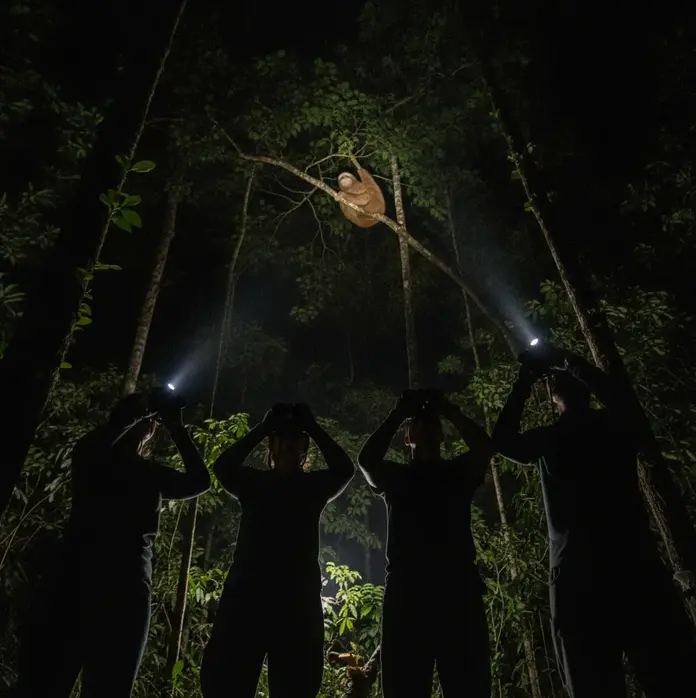
In the late afternoon, between 4 p.m. and 6 p.m., a second observation window opens, particularly for the two-toed sloth, which becomes more active as night approaches. Guided nighttime outings also offer the chance to spot individuals on the move, a rare and memorable experience.
Summary of the best viewing moments
Time of day | Indicative times | Sloth behavior |
Early morning | 6 h – 9 h | Two- and three-toed sloths warming themselves in the sun, more visible at the top of the canopy. |
Midday | Around noon | Animals take shelter in shaded areas, making observation more difficult. |
Late afternoon | 16 h – 18 h | Resumption of activity, especially for the two-toed sloth. |
Night | After nightfall | Two-toed sloths in motion, observable during guided outings. |
To take advantage of these optimal windows, it is essential to be in the forest at the right time, which means staying in the immediate vicinity of the canopy. An eco-lodge stay in the heart of the forest—such as those offered by Pure Brazil Tour on the Rio Negro—allows you to head out at dawn without wasting an hour on travel.

Why a local guide makes all the difference
Essential naturalist expertise
Spotting a sloth without an accompaniment is often a matter of chance. A naturalist guide trained in observing Amazonian wildlife knows how to read the forest differently: he spots droppings on the ground (a sign that a sloth regularly comes down from the same tree), he identifies the cecropia trees frequented, and he knows the transition zones between dense forest and riverbank where these animals are most active.
Intimate knowledge of the Amazonian territory
At Pure Brazil Tour, the guides who lead the Amazon tours come from the communities living along the Rio Negro. Their knowledge of the terrain is intimate, passed down through generations. They know where to look, at what height, and how to direct your gaze toward a silhouette you would never have noticed on your own. This local expertise makes all the difference between a fruitless outing and an unforgettable encounter with a three-toed sloth in its natural habitat.
To learn more about what travelers actually experience during these outings, you can consult the testimonies of those who traveled with us.
Which season is best for observing Amazonian wildlife?
Observe the sloths during the high water season
The question of the ideal time to visit often arises. In the Brazilian Amazon, the two main seasons directly influence access to observation areas. During the high-water season (from approximately December to June), large sections of the forest are flooded, allowing canoes to reach the canopy and approach sloth trees by water. The vegetation is lush, and the animals, less disturbed by the trails, are sometimes easier to approach.
The advantages of the dry season for observation
During the dry season (July to November), the hiking trails are accessible, the riverbanks are exposed, and visibility in the undergrowth is better. Both seasons offer favorable conditions, but different experiences. Our complete guide on When to go to the Brazilian Amazon will help you choose the period that best suits your needs.
Observing sloths ethically
Minimize stress for lazy people
Wildlife observation in the Amazon involves responsibility. Sloths are particularly sensitive to stress. Getting too close, making noise, or worse, trying to touch them or pull them down from a tree can cause real physiological distress and disrupt their essential rest cycles.
A few simple rules for responsible observation
Here are the rules to follow for respectful observation:
Maintain a distance of at least five meters and never attempt to touch the animal.
Avoid using camera flashes, which can disorient the sloth and impair its night vision.
Do not imitate sounds to attract its attention or make it move.
Follow the guide's instructions in all circumstances and do not stray from the group.
These principles are part of a broader approach to responsible tourism in the Amazon, which Pure Brazil Tour promotes across all its tours. You can learn more about this topic by reading our article on eco-responsible tourism in the Amazon.
FAQ
Are sloths dangerous to travellers?
No, sloths pose no danger to humans under normal observation conditions. They are herbivores, slow-moving, and not particularly aggressive. However, their claws are long and sharp, used for gripping branches. Therefore, you should never try to handle them or force them down from a tree.
Can you see sloths on a three or four day tour starting from Manaus?
Yes, absolutely. Our immersive three- to four-day Amazon rainforest tours include outings specifically designed for wildlife viewing, including sloths. The length of the trip allows for multiple outings at different times of day, significantly increasing your chances of spotting them. Discover our three-day immersion tour in the Amazon for more details.
What is the difference between a two-toed sloth and a three-toed sloth?
The two-toed sloth (Choloepus) is larger, with an elongated snout, and is primarily nocturnal. The three-toed sloth (Bradypus) is smaller, recognizable by its rounded face and dark facial mask. The latter feeds almost exclusively on cecropia leaves, which makes it easy to locate in the Brazilian Amazon rainforest.
Observe the sloths in the Amazon with patience and respect
Patience, preparation and local support
Observing sloths in the Amazon is an experience that rewards patience, curiosity, and respect for the natural environment. With the right landmarks, the right timing, and especially the accompaniment of an experienced local guide, these encounters become accessible, even during a stay of just a few days.
Prepare for the next stage of your Amazonian exploration
If you wish to prepare for your trip to the Amazon rainforest and discover the other iconic species you may encounter, consult our complete guide to the animals of the Amazon rainforest.


Comments