.png)

Sur les traces du jaguar en Amazonie | Pure Brazil Tour
- Aug 6
- 8 min read
The jaguar is one of the most fascinating and elusive figures of the Amazon rainforest. An apex predator, it silently rules over a vast territory, remaining almost invisible to those who cannot read the signs of its presence. Traveling to the Amazon in hopes of catching a glimpse of one means embracing a sense of mystery—and that is precisely what makes this quest so special. At Pure Brazil Tour, we prefer to be upfront with you: spotting a jaguar in the Brazilian Amazon is extremely rare. Yet, understanding this animal, tracking its movements, and grasping the role it plays in the ecosystem is, in itself, a profound and unforgettable experience.
In the following lines, we invite you to explore in detail what the encounter with the jaguar in the Amazon really represents, between biology, ecology, conservation issues and the reality of observation in the field.
The Ghost of the Jungle: On the Trail of the Jaguar in the Amazon
The Amazonian jaguar, who is it really?
Morphology of the Amazonian jaguar
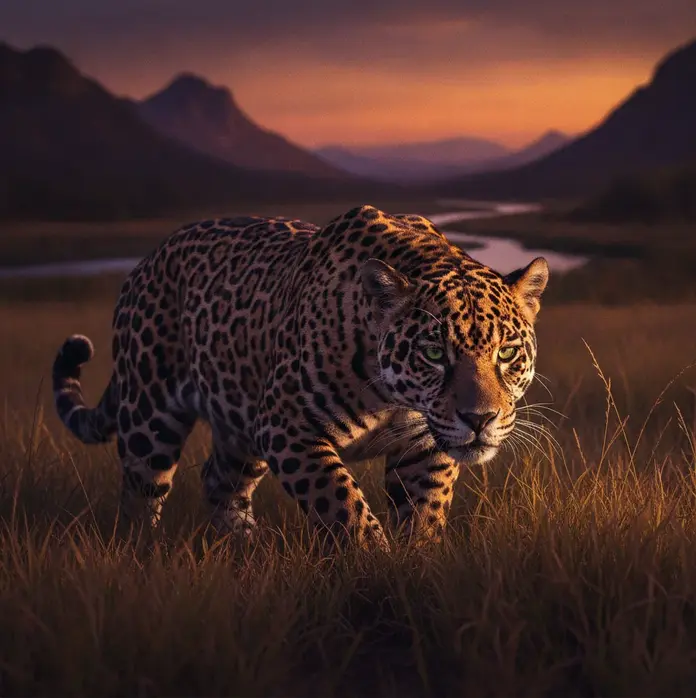
The jaguar (*Panthera onca*) is the largest feline in the Americas and the third-largest in the world, after the tiger and the lion. Its massive body, broad head, and coat patterned with black rosettes featuring central spots clearly distinguish it from the leopard, which it resembles at first glance. An adult measures between 1.10 and 1.90 meters in length, with a shoulder height of 67 to 76 centimeters. It has a powerful build, well-suited to dense forests, floodplains, and waterways.
Element | Data |
Scientific name | Panthera onca |
Rang | Largest feline in America, third largest in the world |
Size | 1.10 to 1.90 m long; 67 to 76 cm at the withers |
Melanistic variation | 6 to 10% of the population |
Life expectancy | About twelve years |
Melanistic variation of the jaguar
There is a melanistic variation, often called the "black panther," which represents between 6 and 10% of the population. It is not a distinct species, but simply a jaguar whose very dark pigmentation obscures the rosettes. Camera traps set up by conservation teams have captured images of these individuals in the Amazon, demonstrating the genetic diversity still preserved in certain areas.
In the wild, jaguars live an average of twelve years. They are solitary, territorial, and spend much of their time patrolling and marking their territory. Their activity is primarily at dusk and dawn, making daytime sightings even rarer.
Where does the jaguar live in the Amazon rainforest?
Jaguar range in the Amazon
The jaguar's range extends from Mexico to northern Argentina, encompassing all of Central and South America. However, the largest populations are still found in the Amazon, in tropical rainforests, seasonally flooded areas, and gallery forests along waterways.

Zone or indicator | Data |
Distribution area | From Mexico to northern Argentina |
South American population | Approximately 163,000 individuals, a figure that is debated. |
Habitat reduction | 60% on the American continent |
Population density in the Brazilian Amazon | 6 to 7 adult individuals per 100 km² |
Status in Brazil | Endangered species |
Local population densities and populations
The South American population is estimated at around 163,000 individuals, although this figure remains debated among scientists. What is certain, however, is that the jaguar's original habitat has already been reduced by 60% in the Americas. In Brazil, the jaguar is officially classified as an endangered species, with varying status depending on the region.
In the Brazilian Amazon, population densities recorded in some protected areas are around 6 to 7 adult individuals per 100 km². This may seem low, but for a predator of this size, which needs a vast territory to hunt, it is a significant figure. It also underscores why the protection of large, continuous forest areas is absolutely essential for its survival.
How does the Amazonian feline hunt and live?
Diet and hunting techniques
The jaguar is an opportunistic apex predator. It feeds on a wide variety of prey: mammals of all sizes, birds, reptiles, fish, and even caimans. It is a remarkable swimmer, perfectly at home in the waterways of the Amazon, which gives it a considerable advantage in an environment where rivers shape the landscape.
Its hunting technique is based on stealth and surprise. It approaches its prey silently, then attacks with formidable force and precision, capable of killing with a single bite to the skull. Its name, in several Native American languages, means "the one who kills in a single leap." It devotes 50 to 60% of its active time to hunting and patrolling its territory, primarily at dawn and dusk.
Activity pattern of the Amazonian jaguar
Its highly developed night vision allows it to hunt in the twilight of the dense forest, where even an experienced guide struggles to distinguish the outlines of the trees.
The jaguar, silent guardian of the ecosystem
A key ecological role in the Amazon
Beyond its iconic status, the jaguar plays a fundamental ecological role. As a keystone predator, it regulates the populations of numerous species and contributes directly to the balance of the Amazonian ecosystem. Without it, certain populations of herbivores or intermediate prey could explode, leading to accelerated vegetation degradation and a loss of biodiversity.
Cascading effects on the ecosystem
This is what ecologists call a cascading effect: the disappearance of a large predator doesn't just leave a "void," it destabilizes the entire system. Looking for jaguar tracks during a stay in the forest is therefore also a way to understand why its presence is a sign of a healthy forest, a still intact environment, a functioning ecosystem.
Why is seeing a jaguar in the Amazon so rare?
Very specific observation conditions
It's important to be honest about this, and that's precisely what we do at Pure Brazil Tour. The Amazon is not the Pantanal. In the Pantanal, the more open vegetation and the concentrations of prey near waterholes create ideal conditions for observing jaguars from boats or riverbanks. The spectacular videos you may have seen were filmed there, in that radically different environment.
In the Amazon, the forest is dense, distances are vast, and the jaguar is a master at vanishing. Even native guides who have known these forests since childhood can go weeks without catching a glimpse of one. What you can hope to find, however, is something else—and it is already significant:
Footprints in the mud, by a stream or on a forest path
Claw marks on tree trunks, territorial signatures left at eye level
Droppings or remains of prey that betray the recent passage of a large predator
Testimonies from native guides who know the usual routes.
Reading these clues with an experienced guide is like entering another dimension of the forest. You no longer see the same landscape. Every track becomes a story, every rustle a possibility.
The threats facing the jaguar
A worrying conservation status
The jaguar's conservation status is officially "Near Threatened" according to the IUCN Red List, but scientists agree that the actual situation could justify a reclassification to "Vulnerable." The trends are worrying.
Deforestation, conflicts and illegal trafficking
Deforestation is the primary threat. Agricultural expansion, intensive cattle ranching, and infrastructure development fragment jaguar habitat, isolating populations that can no longer interbreed. This habitat destruction is compounded by conflicts with ranchers, who sometimes kill jaguars in retaliation for livestock losses, and by illegal trafficking, fueled by demand in certain Asian markets for the animal's teeth, bones, and hides.
GPS collar and camera trap tracking programs have been implemented by NGOs and research teams to better understand jaguar movements and adapt conservation strategies. This data is invaluable for identifying ecological corridors that should be prioritized for protection.

FAQ
Does the jaguar have natural predators in the Amazon?
No. The jaguar is at the top of the food chain and has no natural predators in its environment. Its only real enemy is humankind, through direct hunting, retaliatory measures related to livestock farming, and habitat destruction. This is precisely why its decline has such significant consequences for the entire ecosystem.
What is the difference between a jaguar and a leopard?
The two felines resemble each other, but the jaguar is significantly larger and more robust. Its head is broader, its body stockier. The rosettes on its coat contain a central black spot, which is not the case with the leopard. The jaguar is also a much better swimmer. Finally, the two species do not share any territory: the jaguar lives exclusively in the Americas, the leopard in Africa and Asia.
Can other large predators be observed during a stay in the Amazon?
Yes, and the Amazonian wildlife holds many surprises. The black caiman, the pink river dolphin (boto), the white-lipped peccary, and the anaconda are among the species you can hope to see on an excursion with a native guide. To learn more about the iconic animals of the rainforest, you can consult our guide to 10 species to see in the Amazon.
The forest as a total experience
Learning to live in the Amazon rainforest
Going in search of the jaguar in the Amazon is, above all, about learning to inhabit the forest differently. It's about slowing down, sharpening your senses, learning to read the ground, a tree trunk, a riverbank. It's about understanding that the forest doesn't reveal itself to those who pass by quickly. The native guides who accompany our trips grew up in these environments. They know where to look, how to interpret the signs, and they transmit an understanding of the living world that cannot be acquired from books.
Immersive stays and ecolodges in the Amazon
Whether you choose an immersive multi-day stay departing from Manaus or an eco-lodge experience on the Rio Negro, you will leave with something rare: a different relationship with the wilderness. To discover how we craft these experiences, visit our page dedicated to Amazon eco-lodge tours.
The jaguar, a mystery that reveals the Amazon
An indicator of forest health
The jaguar remains elusive, but it is never absent from the Amazonian experience once you take the time to understand its tracks, its role, and the threats it faces. By learning to read the forest, you also discover why this great cat is one of its best indicators of health. This is the true power of this quest: the jaguar remains a phantom, but a phantom that reveals the living Amazon.
Plan your trip to the Amazon with Pure Brazil Tour
Seeing a jaguar is a dream come true, but a real trip to the Amazon is much more than just ticking off a species on a list. At Pure Brazil Tour, we design immersive experiences that allow you to understand the rainforest in all its richness: learning to recognize the tracks left on the riverbanks, listening to the stories of native guides, discovering the habits of wildlife, and understanding the connections that bind each species to its environment.
We choose transparency: in the Brazilian Amazon, spotting a jaguar remains exceptional. Rather than promising an improbable encounter, we offer an authentic experience, respectful of nature and guided by those who live in the heart of the forest. It is often this immersion, far more than simply observing an animal, that leaves a lasting impression on our travelers.
Do you dream of discovering the Amazon in a different way? Contact Pure Brazil Tour to create a tailor-made trip, accompanied by passionate local guides, bringing you closer to nature and Amazonian cultures. Your adventure begins long before you arrive in the rainforest.


Comments